Hosting and Exposure
Set up the network around the guardian host: its one inbound port, its outbound connections, its ingress, its address and certificate, and its firewall rules.
Inbound Port
The guardian stack publishes a single port, 443/tcp. The front door, a reverse proxy, terminates TLS on that port for GUARDIAN_HOST and, when it is set, for GUARDIAN_HOST_IP, and routes each request by its path:
| Path | Goes to | Used by |
|---|---|---|
/auth/* | Identity service | Operators' browsers, for sign-in and identity administration |
POST /nodes/<id>/credential | API server | Machines that renew, including a machine whose credential has expired |
| Telemetry (OTLP) | Telemetry intake | Machines that export metrics and flow records |
GET /ca/<authority>/… | API server | Anyone who checks a certificate your authorities issued: each authority's revocation lists and chains, with no sign-in |
| Everything else | Operator console | Operators' browsers |
Nothing else is published. The state store and the metrics store sit on an internal network with no route off the host. Operators reach the API server only through the console. Your bootstrap nodes run on your own machines, not on this host.
Operators and machines reach the guardian on 443/tcp, and on no other port. The API server also connects out over HTTPS. For an online deployment, it renews the realm credential with VeilNet. Unless you turn it off, it checks GitHub every hour for a newer conflux release. Every six hours, it probes the TLS endpoints you watch. A failure of any of these stops nothing. The admin nodes send UDP out to your own bootstrap nodes, and nothing connects back in. The state store and the metrics store sit on an internal network with no route off the host.
Ingress
GUARDIAN_INGRESS sets how browsers and machines reach the front door:
| GUARDIAN_INGRESS | How the guardian is reached |
|---|---|
direct | On the published 443/tcp, for the console, sign-in, renewal and telemetry. This is the default. |
cloudflare | Through a Cloudflare tunnel, for the console, sign-in and renewal at GUARDIAN_HOST. The tunnel runs in the stack, dials out to Cloudflare and publishes nothing. Machines send telemetry to 443/tcp at GUARDIAN_HOST_IP, straight to the front door. |
With tunnel ingress, 443/tcp stays published on GUARDIAN_BIND_ADDR, and machines reach it at GUARDIAN_HOST_IP. Behind NAT, forward the port to the host. With the internal certificate, every manifest carries the stack's certificate authority, so machines verify the telemetry endpoint with nothing installed.
Save the tunnel's token as
secrets/cloudflared_token. The token is the string after--tokenon the dashboard's connector page.
To return to direct ingress, set GUARDIAN_INGRESS=direct and run setup again. Setup removes the tunnel.
With tunnel ingress, operators' browsers and machine renewals reach GUARDIAN_HOST at Cloudflare's edge. The tunnel runs inside the stack. It dials out to the edge, publishes nothing and carries each request to the front door's tunnel port, 8444. Machines send telemetry to 443/tcp at GUARDIAN_HOST_IP, straight to the front door. The admin nodes send UDP out to your bootstrap nodes. The API server connects out over HTTPS to renew the realm credential, for an online deployment only, to check for a newer conflux release and to probe the TLS endpoints you watch. The state store and the metrics store sit on an internal network with no route off the host.
Outbound Connections
The stack opens these outbound connections:
| Connection | When | If it fails |
|---|---|---|
| Realm credential renewal, over HTTPS to VeilNet. Redirects are not followed. | Online deployments only. An offline credential has no renewal address, so the guardian never makes this call. | The guardian records the failure and tries again. Nothing stops. |
| conflux updates, over HTTPS to GitHub: api.github.com, then github.com and the host its release downloads come from | Every hour, unless GUARDIAN_CONFLUX_UPDATES is off. Setup also reads conflux's release from GitHub when it builds the stack. | The release in use keeps running, and the API server tries again at the next check. |
| TLS probes, from the API server to each TLS endpoint you watch | Every six hours, and when a manager asks. | The endpoint reads as unreachable. Nothing else changes. |
| UDP from the admin nodes, in the API server's container, to each of your bootstrap nodes | Always. Nothing connects back in. | In-band telemetry shows machines as unreachable, and the console refuses control actions until a route exists. |
| The tunnel, to Cloudflare | Tunnel ingress only. The tunnel dials out and publishes nothing. | The stack restarts the tunnel, which connects again. Telemetry keeps arriving on 443/tcp at GUARDIAN_HOST_IP. |
In brokered mode, the identity service also connects to your identity provider, which can stay inside your network. With GUARDIAN_TLS=acme, the front door reaches the certificate authority to fetch and renew its certificate.
Turning console control off does not change these connections. With GUARDIAN_CONSOLE_CONTROL=off, the admin nodes still connect out to request telemetry. See Console Control.
Address and Certificate
GUARDIAN_HOST is the one address that operators and machines use to reach the guardian. It does not need to be public, or even in DNS. Use it exactly as you set it, because sign-in redirects and the renewal address in every manifest are built from it. GUARDIAN_HOST_IP adds this host's IP address as a second address. The front door answers on it, and its certificate names it. Browsers and renewal still use GUARDIAN_HOST, and a browser that starts at the IP address ends up at the name when it signs in.
The address can take three forms:
- An IPv4 address, which works as it is.
- A DNS name. Create the record yourself, in internal DNS or as a hosts entry on each operator's machine and each node.
localhost, with the port kept off the network. Use it to try the console through an SSH tunnel. No machine can renew against it.
GUARDIAN_TLS sets where the front door gets its certificate:
| GUARDIAN_TLS | Where the certificate comes from |
|---|---|
internal | A certificate from the guardian's own certificate authority, issued for GUARDIAN_HOST and GUARDIAN_HOST_IP. This is the default, and it works offline. Install secrets/tls/ca-public/ca.crt as trusted on every operator's machine and every node. Otherwise, browsers show warnings and machines refuse to renew. Telemetry needs no install, because every manifest carries the certificate authority. |
own | Your own certificate and key, named by GUARDIAN_TLS_CERT and GUARDIAN_TLS_KEY. Setup checks that the key matches, that the certificate names both addresses and that it is in date. It also warns when 30 days or fewer are left. When you renew the certificate, run setup again: it copies in the new files and the front door loads them. |
acme | A certificate that the front door fetches and renews over TLS-ALPN on 443. It names only GUARDIAN_HOST, and needs direct ingress. The address must be in public DNS and point at this host, and the host needs internet access. Set GUARDIAN_ACME_EMAIL to the address where the certificate authority sends expiry notices. |
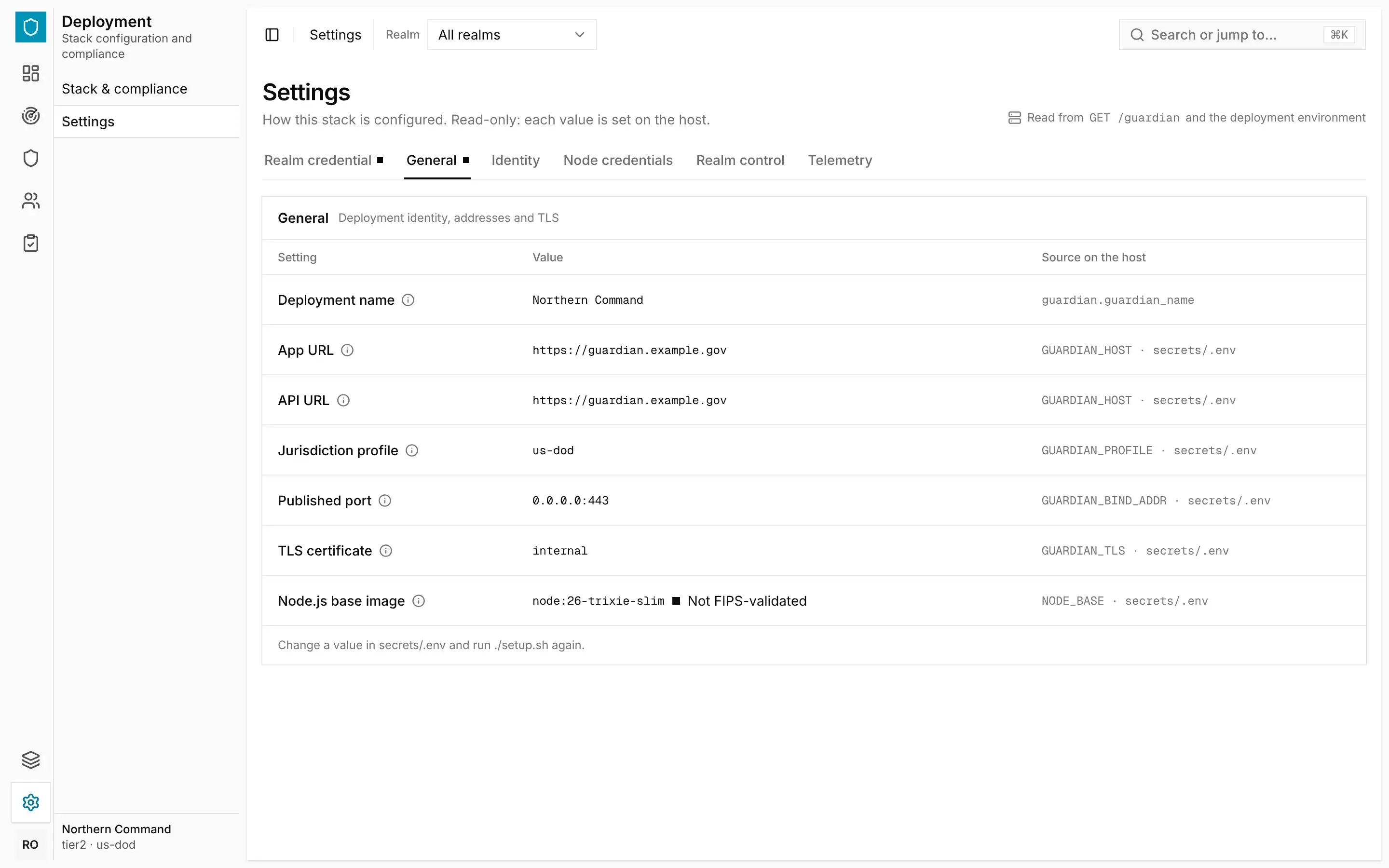
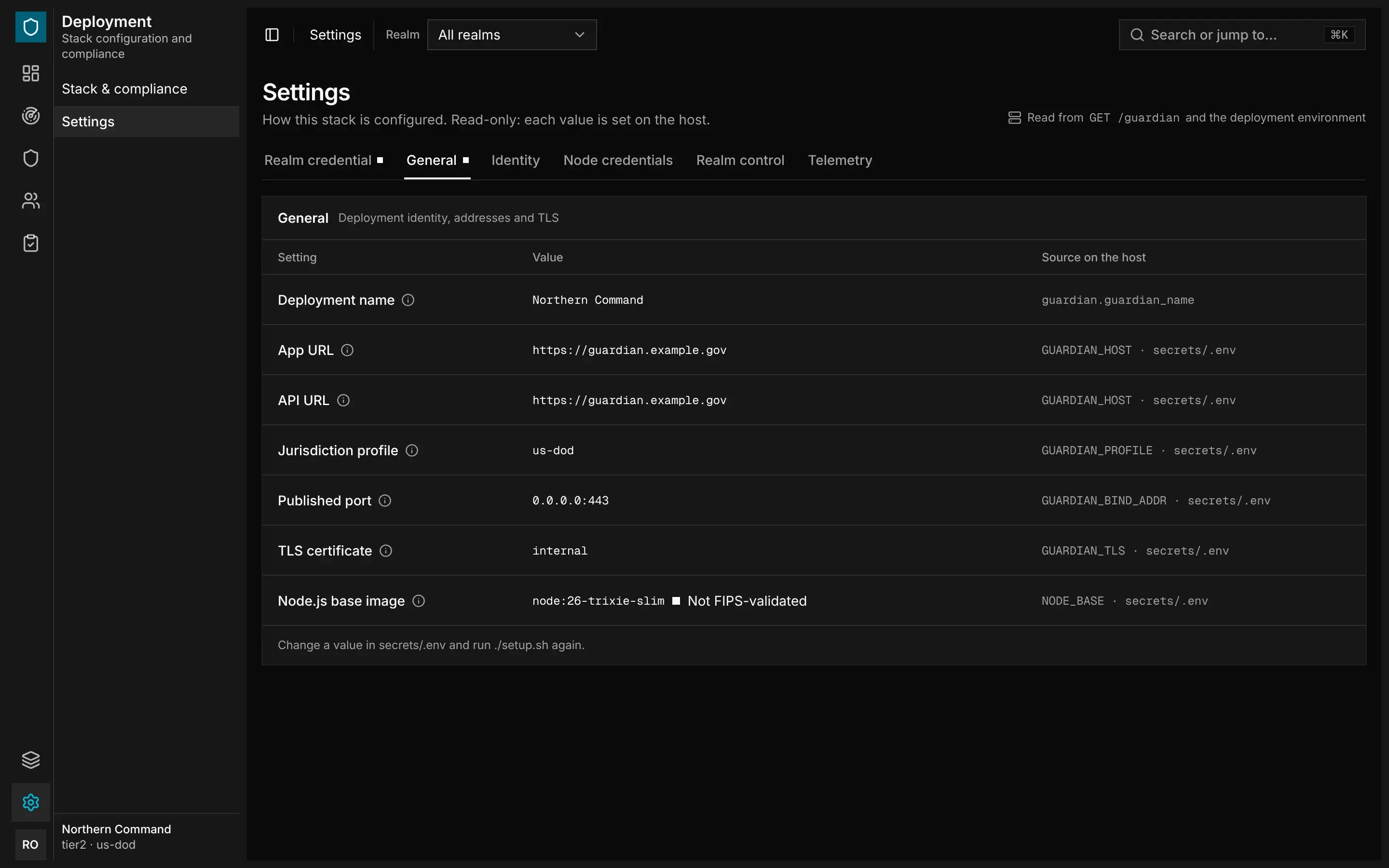
Read-only: each value names the setting on the host that it comes from.
Firewall Rules
Add these rules to the guardian host's firewall:
Allow traffic to the address in
GUARDIAN_BIND_ADDRfrom the networks your operators and machines use. By default, the stack listens on every address.
Edge Protections
The stack protects its published port in these ways:
| Protection | What it does |
|---|---|
| Unauthenticated access | Without sign-in, the API server answers only two health probes and the renewal route. It also serves the certificate authorities' revocation lists and chains under /ca/. These routes serve published files and sign nothing. Each machine renews with its own secret, and every refusal looks the same to the caller. |
| Rate limits | The renewal route accepts 10 requests a minute from one source, and /ca/ accepts 60 a minute from one address. Every other API route accepts 120 requests a minute from each operator, and 1,200 a minute from any one address. |
| No caching | Every response from the API server and the console carries Cache-Control: no-store. No browser or intermediate cache keeps a manifest or a control credential. |
| Telemetry credentials | The telemetry intake accepts data only with a machine's own collector credential, which is separate from its renewal secret. Revoking a machine cuts off its telemetry at once. |
| Never framed | The console answers with X-Frame-Options: DENY, so no other page can frame it. |
| Bounded sign-ins | The console holds a bounded number of sign-ins in progress, and reads no request body before it has checked the session. |
| No OCSP fetch | The front door makes no OCSP request, so a certificate of your own causes no outbound call. |
Planning a Deployment
- To prepare the host and run setup, see Deploying a Guardian.
- For a host with no route out, see Air-Gapped Installation.
- To see where the guardian fits in a sovereign network, see Sovereign Networks.